

How To Uninstall Net Framework Windows 10
This browser is no longer supported.
Upgrade to Microsoft Edge to have advantage of the latest features, security updates, and technical support.
How to remove the .Internet Runtime and SDK
Over time, as you install updated versions of the .Cyberspace runtime and SDK, you lot may want to remove outdated versions of .Internet from your machine. Removing older versions of the runtime may change the runtime chosen to run shared framework applications, equally detailed in the article on .Net version selection.
Should I remove a version?
The .Internet version selection behaviors and the runtime compatibility of .NET across updates enables safe removal of previous versions. .Net runtime updates are compatible within a major version band such as six.x and 5.x. Additionally, newer releases of the .NET SDK generally maintain the ability to build applications that target previous versions of the runtime in a compatible way.
In general, you simply need the latest SDK and latest patch version of the runtimes required for your application. Instances where you might want to proceed older SDK or runtime versions include maintaining projection.json-based applications. Unless your application has specific reasons for earlier SDKs or runtimes, you may safely remove older versions.
Determine what is installed
The .Net CLI has options y'all can use to list the versions of the SDK and runtime that are installed on your estimator. Utilise dotnet --list-sdks to see the list of installed SDKs and dotnet --list-runtimes for the list of runtimes. For more information, run across How to check that .Internet is already installed.
Uninstall .NET
.NET uses the Windows Apps & features dialog to remove versions of the .NET runtime and SDK. The following figure shows the Apps & features dialog. You lot tin search for core or .internet to filter and show installed versions of .Net.
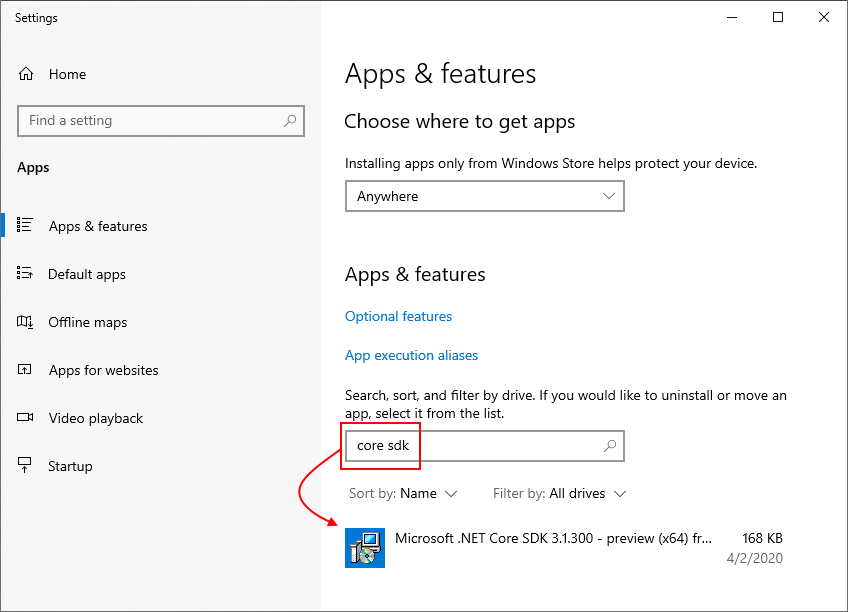
Select whatever versions you want to remove from your computer and click Uninstall.
The all-time way for y'all to uninstall .NET is to mirror the action you used to install .NET. The specifics depend on your chosen Linux distribution and the installation method.
There'due south no demand to first uninstall the .NET SDK when upgrading information technology using a package manager, unless you're upgrading from a preview version that was manually installed. The package manager update or refresh commands will automatically remove the older version upon the successful installation of a newer version. If you have a preview version installed, uninstall it.
If you installed .Cyberspace using a package manager, use that same package manager to uninstall the .Cyberspace SDK or runtime. .NET installations support virtually popular package managers. Consult the documentation for your distribution's packet manager for the precise syntax in your environs:
- apt-get(8) is used by Debian based systems, including Ubuntu.
- yum(eight) is used on Fedora, CentOS, and Oracle Linux.
- zypper(viii) is used on openSUSE and SUSE Linux Enterprise System (SLES).
- dnf(eight) is used on Fedora.
In virtually all cases, the command to remove a packet is remove.
The package name for the .Internet SDK installation for most package managers is dotnet-sdk, followed by the version number. Starting with the version 2.1.300 of the .NET SDK and version 2.1 of the runtime, only the major and minor version numbers are necessary: for example, the .NET SDK version ii.i.300 can exist referenced every bit the bundle dotnet-sdk-2.1. Prior versions crave the entire version cord: for case, dotnet-sdk-2.i.200 would be required for version 2.1.200 of the .NET SDK.
For machines that accept installed only the runtime, and not the SDK, the bundle proper name is dotnet-runtime-<version> for the .Internet runtime, and aspnetcore-runtime-<version> for the entire runtime stack.
Tip
.NET Core installations earlier than 2.0 didn't uninstall the host application when the SDK was uninstalled using the package manager. Using apt-become, the command is:
apt-get remove dotnet-host In that location'due south no version attached to dotnet-host.
If y'all installed using a tarball, you must remove .NET using the manual method.
On Linux, yous must remove the SDKs and runtimes separately, by removing the versioned directories. These directories may vary depending on your Linux distribution. Removing them deletes the SDK and runtime from deejay. For instance, to remove the 1.0.i SDK and runtime, you would employ the following bash commands:
version="1.0.1" sudo rm -rf /usr/share/dotnet/sdk/$version sudo rm -rf /usr/share/dotnet/shared/Microsoft.NETCore.App/$version sudo rm -rf /usr/share/dotnet/shared/Microsoft.AspNetCore.All/$version sudo rm -rf /usr/share/dotnet/shared/Microsoft.AspNetCore.App/$version sudo rm -rf /usr/share/dotnet/host/fxr/$version Important
The version folders may not match the "version" you're uninstalling. The individual runtimes and SDKs that are installed with a single .NET release may have different versions. For example, you may have installed ASP.Internet Core 5 Runtime, which installed the 5.0.2 ASP.NET Core runtime and the v.0.8 .Net runtime. Each has a different versioned binder. For more than information, come across Overview of how .NET is versioned.
The parent directories for the SDK and runtime are listed in the output from the dotnet --list-sdks and dotnet --listing-runtimes command, as shown in the earlier tabular array.
On Mac, yous must remove the SDKs and runtimes separately, by removing the versioned directories. Removing them deletes the SDK and runtime from deejay. For example, to remove the 1.0.ane SDK and runtime, you lot would use the post-obit bash commands:
version="1.0.1" sudo rm -rf /usr/local/share/dotnet/sdk/$version sudo rm -rf /usr/local/share/dotnet/shared/Microsoft.NETCore.App/$version sudo rm -rf /usr/local/share/dotnet/shared/Microsoft.AspNetCore.All/$version sudo rm -rf /usr/local/share/dotnet/shared/Microsoft.AspNetCore.App/$version sudo rm -rf /usr/local/share/dotnet/host/fxr/$version Of import
The version folders may not friction match the "version" you're uninstalling. The individual runtimes and SDKs that are installed with .NET may accept different versions. For instance, you may have installed .Internet v Runtime, which installed the 5.0.2 ASP.NET Core runtime and the 5.0.eight .NET runtime. For more than information, see Overview of how .Internet is versioned.
The parent directories for the SDK and runtime are listed in the output from the dotnet --list-sdks and dotnet --listing-runtimes command, equally shown in the before table.
The .Cyberspace Uninstall Tool (dotnet-cadre-uninstall) lets you remove .NET SDKs and runtimes from a organization. A drove of options is bachelor to specify which versions should be uninstalled.
Visual Studio dependency on .Internet SDK versions
Before Visual Studio 2019 version xvi.iii, Visual Studio installers called the standalone SDK installer for .NET Core version ii.1 or two.2. As a result, the SDK versions announced in the Windows Apps & features dialog. Removing .NET SDKs that were installed by Visual Studio using the standalone installer may break Visual Studio. If Visual Studio has bug after you lot uninstall SDKs, run Repair on that specific version of Visual Studio. The following table shows some of the Visual Studio dependencies on .Net Cadre SDK versions:
| Visual Studio version | .NET Cadre SDK version |
|---|---|
| Visual Studio 2019 version 16.2 | .NET Cadre SDK two.two.4xx, two.1.8xx |
| Visual Studio 2019 version xvi.ane | .NET Core SDK 2.two.3xx, 2.ane.7xx |
| Visual Studio 2019 version 16.0 | .Internet Cadre SDK two.ii.2xx, two.one.6xx |
| Visual Studio 2017 version 15.9 | .Net Core SDK 2.2.1xx, 2.ane.5xx |
| Visual Studio 2017 version 15.8 | .NET Core SDK 2.i.4xx |
Starting with Visual Studio 2019 version 16.3, Visual Studio is in charge of its ain copy of the .NET SDK. For that reason, you no longer see those SDK versions in the Apps & features dialog.
Remove the NuGet fallback binder
Before .Internet Core 3.0 SDK, the .NET Cadre SDK installers used a folder named NuGetFallbackFolder to shop a cache of NuGet packages. This cache was used during operations such every bit dotnet restore or dotnet build /t:Restore. The NuGetFallbackFolder is located at C:\Programme Files\dotnet\sdk on Windows and at /usr/local/share/dotnet/sdk on macOS.
Y'all may want to remove this folder, if:
- Y'all're only developing using .Internet Core 3.0 SDK or .Cyberspace v or subsequently versions.
- Yous're developing using .Net Core SDK versions earlier than iii.0, but y'all can piece of work online.
If you lot want to remove the NuGet fallback folder, you can delete it, but you'll need administrative privileges to practise and then.
Information technology'south not recommended to delete the dotnet folder. Doing so would remove any global tools you've previously installed. As well, on Windows:
- You'll intermission Visual Studio 2019 version 16.iii and later versions. You tin run Repair to recover.
- If there are .NET Cadre SDK entries in the Apps & features dialog, they'll exist orphaned.
Feedback
Submit and view feedback for

How To Uninstall Net Framework Windows 10,
Source: https://docs.microsoft.com/en-us/dotnet/core/install/remove-runtime-sdk-versions
Posted by: cookgiviss74.blogspot.com
0 Response to "How To Uninstall Net Framework Windows 10"
Post a Comment